Surrogates tab
The 5th tab in the strip (Beam · Lattice · Matching · Numerics · Surrogates · Error Study · Failure Study · Results). Train, register, and compare ML surrogate replacements for field-map elements.
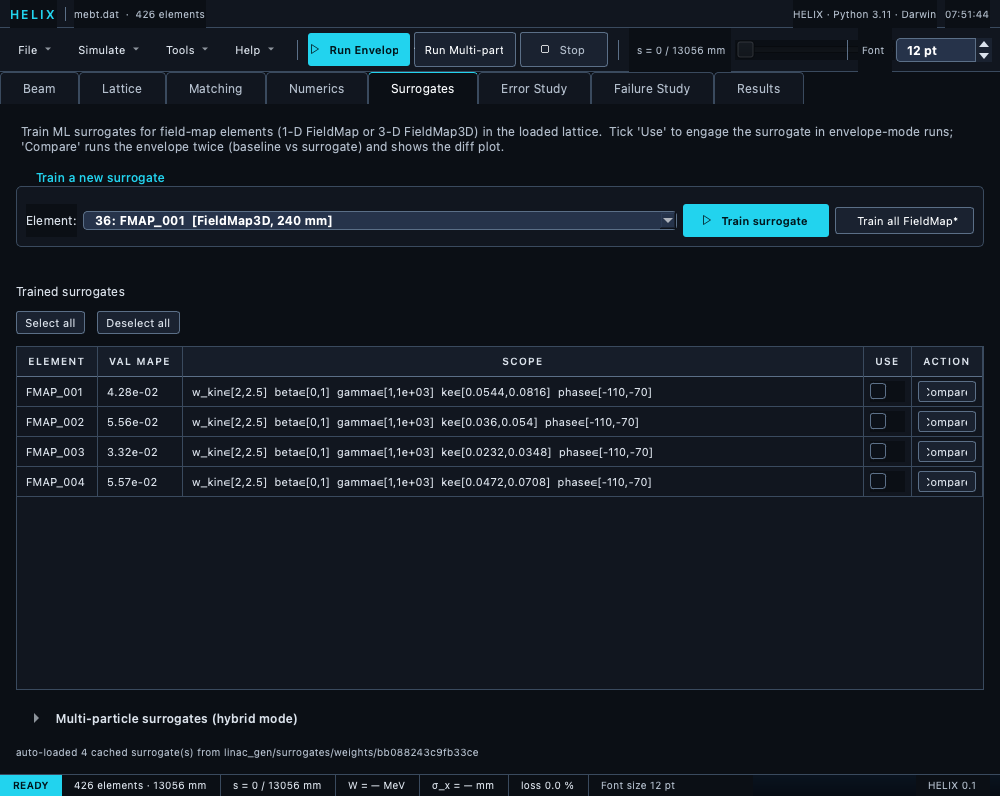
Surrogates tab with the PIP-II MEBT loaded — element dropdown, trained-surrogates table, and the hybrid-MP section.
At a glance
- Element dropdown — every
FieldMap3DandFieldMap(1-D / 2-D cylindrical / quad-gradient) in the loaded lattice. RFQ classes are excluded. - Train surrogate button — modal dialog for samples / epochs /
hidden dims / per-parameter sweep ranges / CPU workers. Runs in
a background
QThread; GUI stays responsive. - Train all FieldMap* button — batch training: a selector dialog lists every FieldMap-class element (all ticked by default, with Select all / Select none buttons) plus shared samples / epochs / hidden-dims / workers settings, then trains the checked elements sequentially.
- Trained-surrogates table — auto-populates from cached weights for the current lattice on load. Per row: element name, val MAPE, scope, Use checkbox (registers it; engages in 0 mA envelope runs — SC runs and per-sub-step recording stay RK4), Compare button. Select all / Deselect all buttons above the table bulk-tick or untick every Use checkbox.
- Cache-aware Train — clicking Train for an element with existing cached weights opens an Open / Retry / Cancel modal: Open loads the cached weights, Retry retrains from scratch.
- Multi-particle surrogates (hybrid mode) — a collapsible
section under the table that engages the same trained surrogates
in multi-particle runs (linear-matrix anchor + cheap RK4
residual). Its Engage in MP runs master toggle drives
registry.set_mp_enabled; Residual RK4 substeps (default 15) trades speed vs accuracy; Compare MP runs baseline-vs-hybrid MP simulations and reports speedup + σ diffs.
Registry is cleared on lattice swap
Loading a different lattice clears the trained-surrogates table and the runtime registry — surrogates trained for the old lattice are never silently applied to the new one. Re-tick Use after training/loading surrogates for the new lattice.
The dedicated ML Surrogates section has the full reference — what they are, when to use, the M3 limitation, training accuracy gates, and the equivalent CLI / Python flows.
Cross-references
- ML Surrogates → GUI walkthrough — the step-by-step recipe with screenshots.
- ML Surrogates → Overview — scope, accuracy, the M3 limitation.
- ML Surrogates → Training guide — sample sizing, multiprocessing, OOD, persistence.