PIC solver
The 3-D Particle-In-Cell solver is HELIX's main space-charge engine for bunched, multi-particle tracking. It solves Poisson's equation in the beam rest frame on a regular Cartesian grid via doubled-grid Hockney FFT convolution.
TL;DR
from linac_gen.core.config import BeamConfig, SpaceChargeConfig
from linac_gen.core.lattice import Lattice
from linac_gen.core.simulation import Simulation
from linac_gen.distributions.factory import create_beam
from linac_gen.elements.drift import Drift
from linac_gen.elements.quadrupole import Quadrupole

# A small FODO + 5 mA beam to feel the space charge:
lattice = Lattice()
for c in range(2):
    lattice.add(Quadrupole(name=f"QF_{c}", length=100.0, gradient=+10.0))
    lattice.add(Drift(name=f"D1_{c}", length=200.0))
    lattice.add(Quadrupole(name=f"QD_{c}", length=100.0, gradient=-10.0))
    lattice.add(Drift(name=f"D2_{c}", length=200.0))
beam = create_beam(BeamConfig(current=5.0, n_particles=2000), seed=42)

sc = SpaceChargeConfig(
    nx=96, ny=96, nz=96,        # the defaults
    grid_extent=5.0,            # ±5σ box
    kernel="cic",               # particle-mesh shape: "cic" or "tsc"
    green_kind="igf",           # Green's function: "igf" or "point"
    use_gpu="auto",             # "cpu" / "gpu" / "cuda" / "mps" / "auto"
)
sim = Simulation(lattice, beam, space_charge=sc)
results = sim.run()
Reasonable defaults:
- Grid: the default is
nx=ny=nz=96(1% σ convergence at 5 mA); drop to 64 for quick tests, 128+ for publication quality. - Extent:
5.0σ-multiples — captures ~99.99% of a Gaussian. - Kernel:
"cic"for legacy compatibility,"tsc"for noise- sensitive long no-RF transports (BTL-style). - Green:
"igf"(always —"point"is legacy reproduction only).
Further SpaceChargeConfig knobs:
| Field | Default | Values | Meaning |
|---|---|---|---|
boundary |
"open" |
open |
Poisson boundary condition — only open-BC (Hockney doubled-grid) is implemented; "periodic" is refused at validation (2026-07: it used to be accepted and silently ignored) |
solver |
"fft" |
fft |
Poisson solver flavour (only FFT is implemented) |
shape_order |
1 |
1 |
deprecated no-op — deposition order is chosen by kernel (cic/tsc); any value ≠ 1 warns |
grid_mode |
"fixed" |
fixed | adaptive |
fixed = grid frozen after the first kick; adaptive = grid re-sized to ±grid_extent·σ on every kick |
The 8-step PIC cycle
At every integration step, the PIC solver:
- Lorentz boost on z to enter the beam rest frame (γ on z only, transverse coordinates unchanged).
- Set up grid — automatically sizes the box to ±
grid_extent·σ in each dimension (or fixed ifgrid_mode="fixed"). - Charge deposition on the grid — either CIC (8-corner trilinear, first-order) or TSC (27-cell quadratic, second-order).
- Doubled-grid FFT convolution with one of two Green's functions:
- IGF (Integrated Green Function, default) — closed-form 8-point cell-difference of the analytic Coulomb antiderivative. Symmetric, free of grid-resolution bias near the source (Qiang et al. 2006).
- point (legacy) — sampled 1/(4πε₀ r) with self-potential regulariser at r = 0.
- E-field gather to particles (matching deposit kernel — CIC or TSC).
- Transverse momentum kick — uses the standard Lorentz cancellation: net lab-frame transverse force = q·E_⊥_rest / γ; the β²γ² factor in the kick formula bundles the γ from force cancellation with the βγ from p_z conversion.
- Longitudinal energy kick — q·E_z_rest applied directly to the lab-frame ΔW (E_z is invariant under the z-boost).
- No explicit boost-back — the kicks are written straight into the lab-frame x′/y′/ΔW columns (the frame transformation is folded into the β²γ² factor of step 6), and the reference particle is never modified.
Reference for the algorithm: Qiang, Lim, Ryne, PRSTAB 9, 044204 (2006) — same kernel used by Cheetah and OPAL.
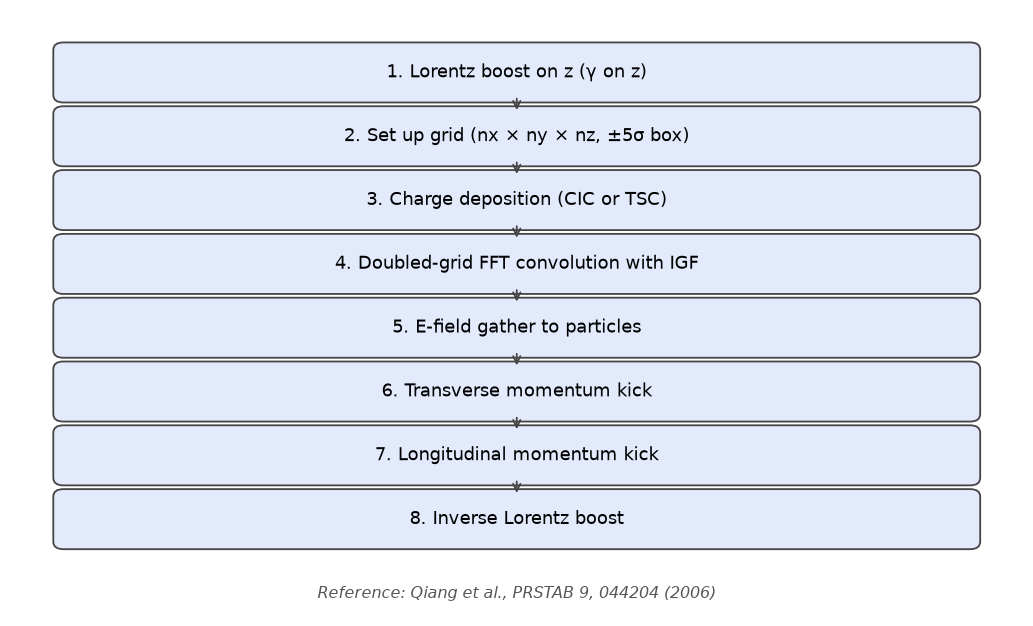
Figure 5.2 — The 8-step PIC cycle as implemented in HELIX. Steps 1 and 8 are the Lorentz boosts that bracket the rest-frame Poisson solve.
CPU / GPU backend
The FFT step of every PIC kick is dispatched through
linac_gen.pic.gpu_backend.FftBackend. Three concrete backends are
shipped:
| Backend | Module | Precision | Runs on |
|---|---|---|---|
_CpuBackend |
scipy.fft (or numpy.fft fallback) | FP64 | host CPU, multi-threaded via workers=-1 |
_GpuBackend |
cupy / cupyx.scipy.fft | FP64 | NVIDIA CUDA device |
_MpsBackend |
torch.fft on MPS | FP32 (Metal hardware) | Apple Silicon GPU |
Selecting a backend
use_gpu= |
meaning |
|---|---|
"auto" |
cupy (FP64) if available, else CPU — never MPS |
"gpu" |
any GPU available (cupy preferred, MPS fallback), error if neither |
"cuda" |
force cupy; error if missing |
"mps" |
force torch.mps; error if missing |
"cpu" |
force scipy.fft on host |
MPS is float32 and requires explicit opt-in
Metal hardware has no FP64, so the MPS backend computes the FFTs in
float32 (~1e-7 relative field error, not float64-reproducible).
"auto" therefore never selects it — on an Apple-Silicon machine
without CUDA, "auto" runs on the (equally fast, full-precision)
CPU backend. Requesting MPS explicitly ("mps", or "gpu" with no
CUDA device) works but emits a UserWarning stating the precision
cost. (Changed 2026-07: previously "auto" silently picked MPS.)
The env var LINAC_GEN_USE_GPU takes precedence over the argument and
accepts the same set of values (plus 0/1 legacy aliases). The GUI
exposes the same options in the Numerics tab's PIC backend
dropdown.
Numerical parity
cudavscpu—~1e-10relative on σ (FP64 FFTs on both paths).mpsvscpu—~6e-7relative on σ (FP32 FFT round-off floor). Far below the PIC macroparticle shot noise (~1/√N≈1e-3forN=10⁴), so MP+SC residuals vs TraceWin are unchanged. For runs where you need sub-FP32 numerical fidelity (e.g. publication figures comparing run-to-run determinism), forceLINAC_GEN_USE_GPU=cpu.
Crossover — NVIDIA
For grids ≤ 96³ on WSL2-class PCIe, host↔device transfer cost can exceed the FFT speedup. Measured (RTX 2000 Ada, 16-thread scipy.fft):
| grid | CPU | GPU (cuda) | speedup |
|---|---|---|---|
| 48³ | 7.6 ms | 4.9 ms | 1.6× |
| 64³ | 17.5 ms | 11.7 ms | 1.5× |
| 96³ | 41.7 ms | 55.5 ms | 0.8× — CPU wins |
| 128³ | 100.6 ms | 128.7 ms | 0.8× — CPU wins |
If your workload uses ≥96³ grids on WSL2, force "cpu" or set
LINAC_GEN_USE_GPU=0.
Crossover — Apple Silicon (MPS)
Apple unified memory makes the host↔device copy effectively free, so small grids stay competitive. PyTorch 2.10's inverse-real-FFT path on MPS is currently slower than scipy.fft (known upstream issue), so the full Poisson round-trip is roughly neutral on small grids and only the forward-FFT half clearly wins. Measured (M3 Max, padded 256³ FFT, FP32 vs scipy.fft FP64):
| step | scipy.fft (CPU) | torch.fft (MPS) | speedup |
|---|---|---|---|
rfftn 256³ |
7.9 ms | 2.6 ms | 3.0× |
irfftn 256³ |
11.0 ms | 42.3 ms | 0.26× (upstream issue) |
| round-trip | 18.9 ms | 44.9 ms | net negative on this grid |
End-to-end MEBT+HWR MP+SC (N=10000, 64³ grid) wall-clock:
| backend | wall-clock | MPS peak alloc | TraceWin parity |
|---|---|---|---|
| CPU | 97.2 s | 0 MiB | 4.07% mean σ_x |
| MPS | 90.1 s | 108 MiB | 4.07% mean σ_x (same at displayed precision; FP32 ⇒ ~6e-7 relative on σ, not bit-identical) |
The MEBT+HWR speedup is modest because deposit/interp and per-element overhead dominate; lattices with proportionally more PIC kicks (full PIP-II, long BTL transport) gain more.
Implementation
linac_gen.pic.pic_solver.PicSolver is the entry point. Internally:
linac_gen/pic/charge_deposition.py—deposit_cic/deposit_tsc, particle → grid.linac_gen/pic/poisson_solver.py—PoissonSolverFFT(Hockney FFT solver) with the IGF antiderivative_antideriv_igf.linac_gen/pic/field_interpolation.py—interpolate_cic/interpolate_tsc, grid → particle.linac_gen._pic_kernels(C++/pybind11) — fast CIC deposit/interpolate paths.
The C++ kernel is built automatically by pip during install. If the
extension is not importable, HELIX logs a warning and falls back to
the pure-Python CIC in charge_deposition.py /
field_interpolation.py (numerically equivalent, slower). TSC has
no C++ kernel and always runs the Python path.
Cross-references
- Models — broader SC-model decision.
- Kernels — CIC vs TSC vs IGF vs point.
- Convergence guide — grid sizing.
linac_gen/pic/pic_solver.py:1— source.